Concrete Saw Cutting for a Plumbing Repair or an Addition: How the Cut Gets Planned
The saw is the last step. Everything that makes a cut safe happens before the blade touches the slab.
A slab cut usually starts with something unwelcome. A plumber has traced a leak under the concrete, a camera found a broken line, or you are adding on and the new drain has to tie into something that is currently buried. Either way, somebody has told you the floor has to be opened.
The cut itself is the fastest part of that job. Everything that makes it a good cut happens before the saw is running.
The first step is locating. Concrete is not empty. A slab can contain reinforcing steel, plumbing lines, electrical conduit, radiant or hydronic tubing, and in some construction, post-tension cables. That last category is the one that deserves real respect: post-tension cables are steel strands held under enormous tension, and cutting one is not a repair problem, it is a safety and structural problem. Before a blade goes in, the slab gets scanned and the layout gets marked, and if what we find conflicts with the cut you need, we move the cut or bring in the engineer who can tell us what is acceptable — we do not split the difference and hope.
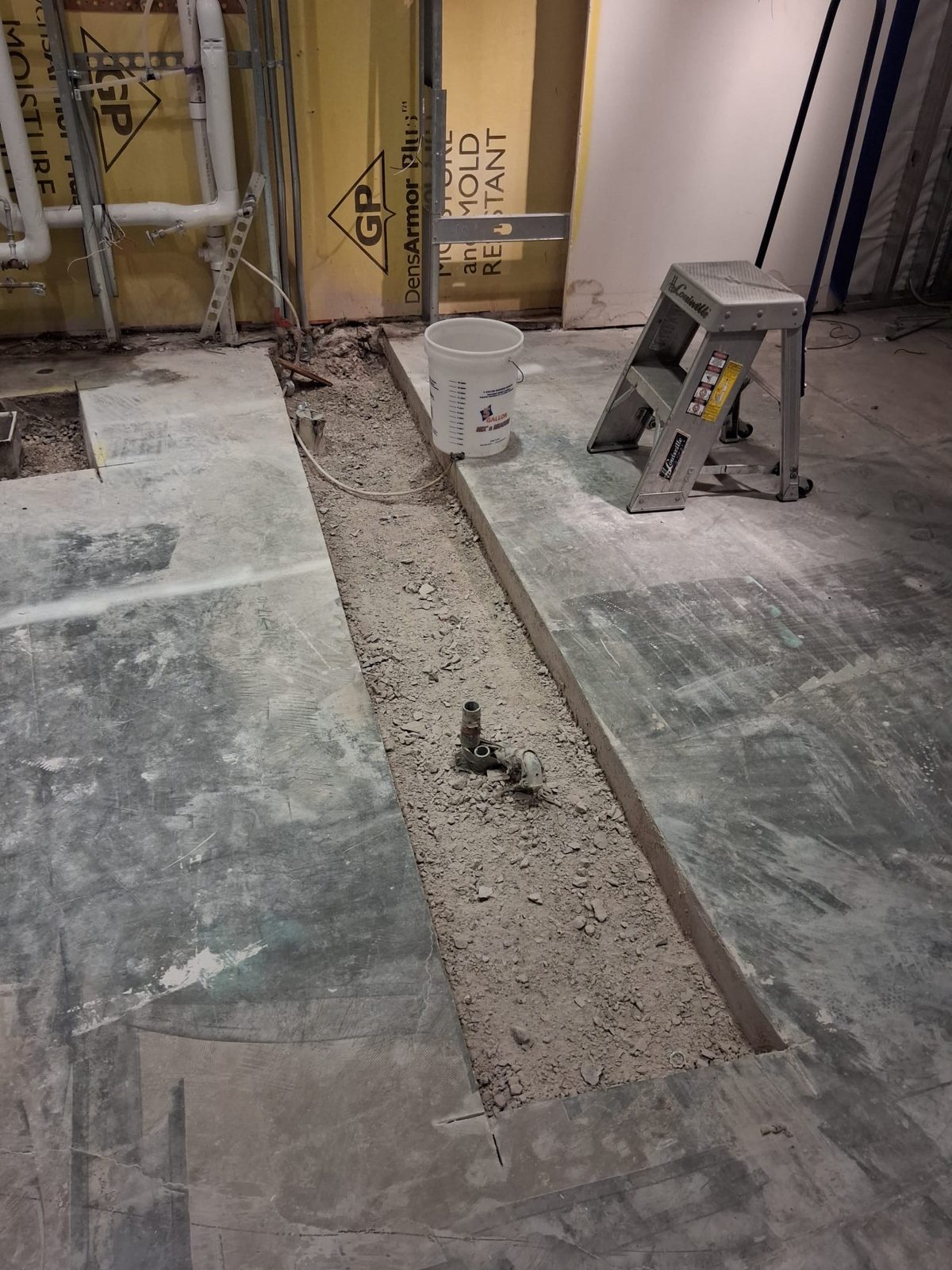
The second step is deciding the geometry. Where a trench runs, how wide it needs to be for the plumber to actually work in it, how deep the cut goes, and where it terminates all get marked out on the floor before anything starts. Cutting slightly oversize deliberately is often smarter than cutting tight and having somebody chip the edges out by hand later. And a cut that stops short of a wall or a footing on purpose is a decision, not an oversight.
The third step is the cut itself, and in almost every interior situation that means wet cutting. Water on the blade controls heat, extends blade life, and dramatically reduces airborne silica dust compared to dry cutting. It also creates slurry — a grey mix of water and concrete fines that runs wherever the floor slopes. Slurry is manageable and it is also the thing that ruins finishes if nobody planned for it. We dam and contain it at the cut, vacuum it up as we go, and keep it off adjacent flooring, out of drains where it should not go, and away from anything downhill. Planning for slurry is as much a part of the job as planning the cut.
Removal comes next. Cut sections of slab are heavy and awkward, and the goal is lifting them out intact rather than breaking them up in the room, because breaking creates dust, noise, and ragged edges. Getting that material out of the building is genuine work, and on interior jobs it is the part that dictates how long you live with an open floor.
The last step is the one that pays off later: clean edges. A saw cut with square, sound edges gives the concrete patch a defined surface to bond to and a straight line to finish against. A jackhammered hole with crumbling, feathered edges gives the patch nothing, and you will see the repair through whatever floor goes down on top of it. When the plan is a tile or vinyl plank floor over the patch, the difference between a sawn edge and a broken one shows up as a visible line in your finished room.
Depth control matters here too. Cutting deeper than necessary means more material to remove, more reinforcing steel cut than needed, and a bigger patch. Matching the cut depth to the slab and the work underneath it keeps the repair smaller.
None of this is exotic. It is just the difference between a contractor who treats a slab cut as a demolition task and one who treats it as the first step of a repair that somebody else has to finish. We scope concrete saw cutting and removal with the patch in mind, because the plumber, the concrete finisher and the flooring installer behind us all inherit the edges we leave.
One practical note for homeowners: tell us early whether the room's existing floor is staying. Saving surrounding tile or plank changes how we protect the area, how we manage slurry, and where we stage debris. It is a much easier conversation before the cut than after.
We are licensed, bonded and insured under Nevada license #0079188, with 14 years in the valley and a 6-person crew serving Las Vegas, Enterprise, Henderson, North Las Vegas, Summerlin and Boulder City. Estimates are free, we walk the site before we quote, and you pay after you see the results. If a plumber or a contractor has told you the slab has to be opened, read through our concrete saw cutting and removal page and then call us to plan the cut.
Need that floor gone?
Floor removal, concrete saw cutting and full interior demolition across the Las Vegas valley — free estimates.