Commercial Flooring Demo After Hours: Working Around a Business
A business can often stay open while its floors are replaced. The demo gets planned around the hours, the people and the access the business actually has.
Commercial flooring demolition can often be done around a business that stays open, by working when the space is closed and handing it back ready to use. It takes more planning than a vacant tenant space, but for many owners and property managers it is better than closing the doors.
Here is how that kind of job gets planned in Las Vegas, and what you should have ready before you call.
Start with how the business actually runs
Before anything else, we need to understand the space. What hours is it open? When do employees arrive and leave? When do deliveries come? Are there areas that can never be closed, like a server room, a pharmacy counter or a reception desk? Is the building shared with other tenants?
The answers shape the whole plan. A restaurant, an office and a retail store can have very different quiet windows, and a medical office has different concerns about noise and cleanliness than a warehouse does.
Phasing the work
Most after-hours jobs are done in phases. Instead of removing the whole floor at once, we work one area at a time, finish it, clean it and make it usable before the business reopens. The next shift picks up where the last one ended.
Phasing takes coordination with whoever is installing the new floor, because each area has to be removed, prepared and — often — covered with new flooring before it is back in use. The order of the phases usually follows how people move through the space, so there is always a working path from the entrance to the areas still open.
Containment in an occupied space
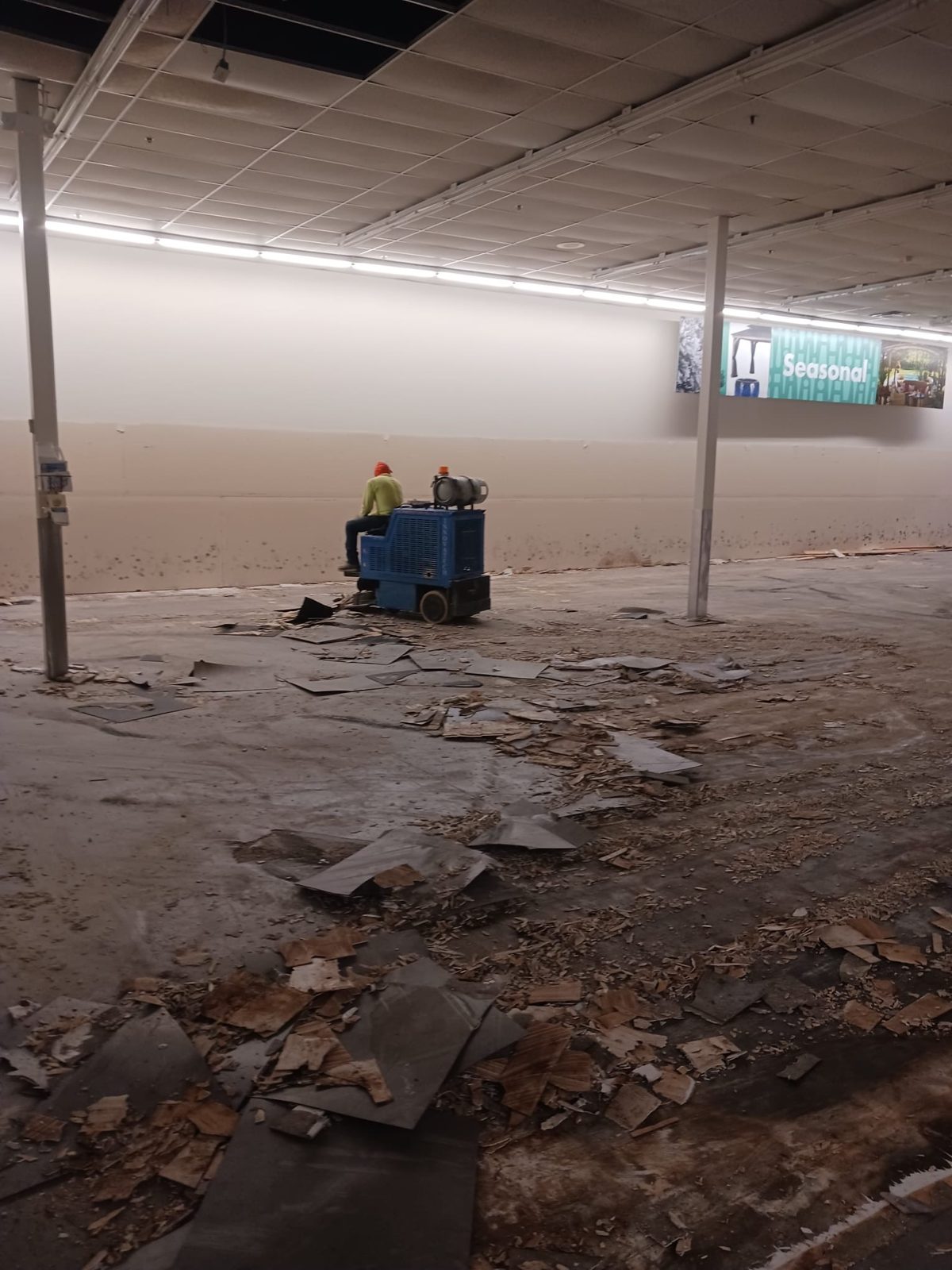
Commercial flooring removal is not dust free, and in a building that will be full of people the next morning, containment matters even more. The work area gets separated with barriers, HVAC returns in the zone get covered, and we work with the building to manage the air system during the shift. Adjacent areas, merchandise and equipment get protected.
At the end of every shift, the space needs to be safe and presentable: debris removed, walking surfaces clear, no loose edges or trip hazards, and barriers in good shape. The goal is that employees and customers can use what is open without working around a construction site.
Access, elevators and loading
In a multi-story or shared building, how material comes in and goes out is often the hardest part of the plan. We will ask about the freight elevator, whether it needs to be reserved, whether it needs protective pads, and what the load limits are. We will ask where debris can be staged and loaded, whether there is a dock, and what the building's rules are for after-hours contractors.
Property managers usually know these answers or know who does. Sharing them early avoids a first night spent waiting for a key or an elevator.
Noise and neighbors
Removal is loud. After hours solves that for the business itself, but not always for neighbors in a mixed-use building or a shopping center with late-hour tenants. Some buildings have rules about when loud work can happen. We plan the loudest tasks around those rules.
What drives the schedule
We will not give you a number of nights without seeing the space. What drives it: the type of flooring and adhesive, the total area, how many phases the business needs, the length of each available work window, how debris leaves the building and how quickly the new floor can be installed behind us. A long shift in an open space moves differently than a short window in a series of small rooms.
After we walk the site and understand the constraints, we give you a written scope and an exact quote.
Communication during the job
On a phased job, the business needs to know what will be closed, when and for how long. A simple plan shared with the owner or property manager — which area is being worked, what should be moved out before the shift and what will be ready in the morning — goes a long way. So does one clear contact on each side.
When closing makes more sense
After-hours work is not always the right choice. Night and weekend shifts can mean shorter work windows, more setup and teardown each shift and more coordination with the building. For some businesses, closing a section — or the whole space — for a short period is simpler overall. We will talk through both approaches honestly and help you decide which fits your business.
Protecting what stays
Fixtures, shelving, equipment and finished surfaces that stay in place need protection every shift. That can mean covering counters, wrapping displays, protecting walls along the debris path and padding elevator cabs. Walking the space together before work starts lets us agree on what is protected, what is moved and who moves it.
What to have ready before you call
Floor plans or a sketch of the space, the flooring types in each area, the business hours and any areas that cannot close, building rules for contractors, elevator and loading details, and the name of your flooring installer if you have one. Even partial answers help us give you a more accurate quote.
Our commercial demolition page covers our work in offices, retail spaces and other commercial buildings, and our carpet, VCT and glue-down removal page covers the floors most businesses have. We work across Las Vegas, Henderson, North Las Vegas, Summerlin, Spring Valley, Paradise and Enterprise. Call for a free estimate and an exact quote.
Need that floor gone?
Floor removal, concrete saw cutting and full interior demolition across the Las Vegas valley — free estimates.