Carpet, VCT and Glue-Down: Why Each One Comes Up Differently
Stretched carpet, glued carpet, VCT and glue-down plank all look like 'soft' floors, but each one is bonded differently — and the adhesive left behind is what shapes the job.
Carpet, VCT and glue-down flooring each come up differently because each one is attached to the floor in a different way. The real work is rarely the flooring itself; it is whatever holds it down and whatever that leaves on the slab once the material is gone.
If you own a home or manage a property in Las Vegas and you are replacing one of these floors, knowing which kind you have will help you understand the quote you get and plan the rest of the project.
Stretched carpet with pad
Most residential carpet is stretched over a pad and held at the edges by tack strip nailed or glued along the walls. Removal means cutting the carpet into manageable strips, rolling it, pulling the pad and taking up the tack strip. The pad is sometimes stapled or glued in spots.
This is generally the most straightforward of the group. The main questions are how much of it there is, whether stairs are involved, what is left behind where the pad was glued, and how the material gets out of the building. Carpet is bulky, so haul-off takes planning even when the removal itself goes smoothly.
Glue-down carpet
Glue-down carpet, common in offices, retail spaces and some rentals, is bonded directly to the slab with adhesive. It comes up in strips, but it does not release cleanly. Backing often tears away from the face, and adhesive stays on the concrete.
What that adhesive does next matters. If the new floor is another glue-down product, some residue may be acceptable depending on the manufacturer's instructions. If the new floor is tile or a product that requires a clean, bare slab, the adhesive has to come off, and that is often where most of the effort goes.
VCT
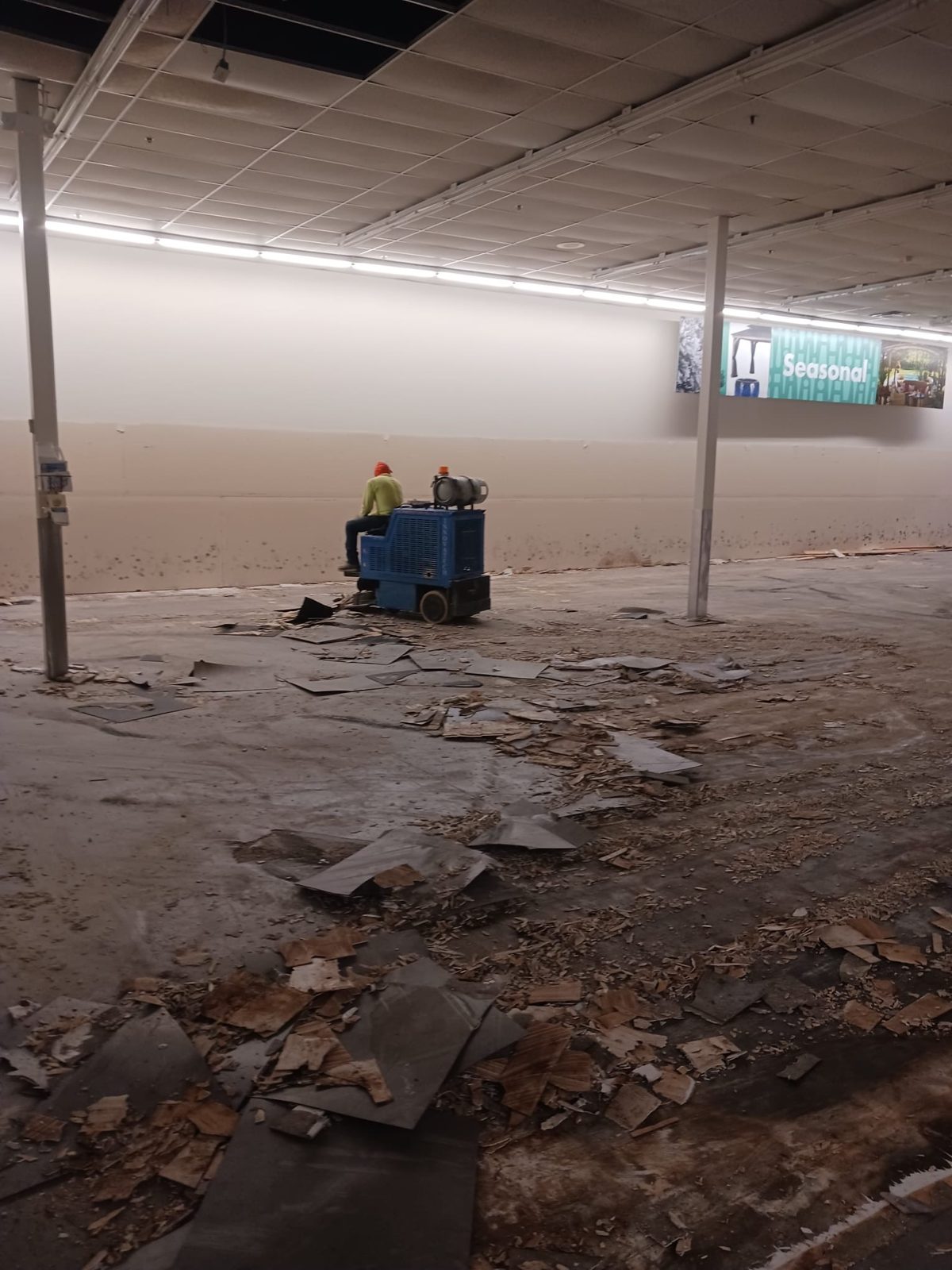
Vinyl composition tile — VCT — is the square commercial tile you see in schools, stores, break rooms and hallways. It is set in adhesive and comes up tile by tile, usually with a scraper. Depending on the age of the installation, some tiles pop loose easily and others hold tight.
Older vinyl tile and the adhesive under it can be a different matter entirely. Some older flooring materials and adhesives may contain asbestos, and that needs to be tested by a qualified testing company before anyone breaks them up. If there is any doubt about what an older floor is, we stop and advise testing rather than guess. We do not perform asbestos abatement.
Glue-down plank and sheet vinyl
Glue-down luxury vinyl plank and sheet vinyl are thinner and more flexible than VCT. Planks usually come up with scraping. Sheet vinyl may come up in large sections or may tear and leave its felt backing behind, stuck to the slab. That backing is what turns a quick job into a slow one.
Floating vinyl plank that clicks together is a different case — it is not glued down at all, and it usually comes up much more easily.
Why the adhesive decides the job
Across all of these floors, the same pattern repeats: the visible material comes up, and then the slab has to be made ready for what is next. The kind of adhesive, how heavily it was applied, how old it is and how clean the next floor needs the slab to be are what drive the scope.
That is also why two quotes for 'carpet removal' can look very different. One may just be pulling carpet, pad and tack strip. Another may include clearing adhesive to a bare slab for new tile. Ask what each quote includes.
What drives time and cost
We will not give you a figure without seeing the floor, but the things that move it are consistent: the type of flooring, how it was installed, the adhesive underneath, whether it is on stairs, the condition required for the new floor, access for equipment and debris, and whether the building is occupied. Commercial spaces add scheduling and access considerations that residential jobs usually do not.
Getting the slab ready for the next trade
The goal of removal is not just an empty room. It is a slab your installer can work with. Before we quote, it helps to know what is going down next and whether your installer has specific requirements. That way the removal is scoped to what the next trade needs instead of what happens to be easiest.
Stairs, edges and transitions
Stairs deserve their own mention. Carpet on stairs is usually stapled and wrapped around the nosing, and every step has to be handled by hand. Glue-down material on stairs is slower still. Edges along walls, cabinets and door frames also take hand work no matter what the flooring is, because equipment cannot reach tight into corners.
Transitions between rooms matter too. Where carpet meets tile or VCT meets a sealed concrete floor, the new floor has to meet the old one cleanly, or the removal has to extend to a logical stopping point. Deciding those lines before removal starts avoids awkward seams later.
Questions to ask before you hire
What exactly is included — just the flooring, or the adhesive too? What condition will the slab be in when you leave? How will debris leave the building? If the flooring is older, what happens if you suspect it should be tested? Clear answers to those questions make quotes easier to compare.
Talk to us before you start
Our carpet, VCT and glue-down removal page covers how we approach these floors in homes and commercial spaces. We work throughout Las Vegas, Henderson, North Las Vegas, Summerlin, Spring Valley, Paradise and Enterprise. Call for a free estimate; we will look at what is on the floor and what is under it, and give you an exact quote.
Need that floor gone?
Floor removal, concrete saw cutting and full interior demolition across the Las Vegas valley — free estimates.